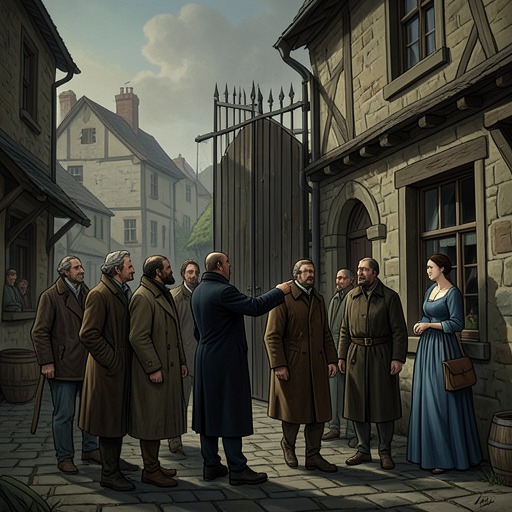
Pietro Boccamazza
The DecameronPietro Boccamazza’s story turns a forbidden elopement into a test of love under pressure: rejected by his family’s expectations, he flees Rome with Agnolella, loses her in a dangerous wood, and must endure uncertainty before they can be reunited and marry.
Identity, Love, and Flight
Pietro is introduced as a young man from a distinguished family in Rome. He falls in love with Agnolella, the beautiful daughter of Gigliuozzo Saullo, a plebeian who is nevertheless greatly esteemed by the Romans. Pietro’s love is returned, but the difference in their families’ standing gives the match a social cost: when his relatives learn that he wants to marry her, they reproach him and warn Agnolella’s father not to take Pietro’s words seriously, lest he lose their friendship and kinship.
Pietro does not abandon his purpose. Once an intermediary has established that Agnolella is willing, he agrees with her to leave Rome together. They set out early one morning on horseback for Anagni, where Pietro has trusted friends, without time to celebrate a wedding because they fear pursuit. Their journey begins in the intimacy of a pair imagining a life together: as they ride, they speak of their love and kiss. But Pietro is unfamiliar with the way. About eight miles from Rome, he takes a left-hand path instead of the road to the right, and the mistake carries them toward danger.
Near a small castle, a dozen footmen suddenly emerge. Agnolella notices them first and turns her horse toward a nearby wood, urging it on at a gallop. Pietro, watching her rather than the road, reacts too late. The attackers seize him, make him dismount, and identify him as connected to their enemies; they propose taking his clothes and horse and hanging him from an oak to spite the Orsini family. As Pietro is ordered to undress, an ambush of about twenty-five armed men surprises his captors. The attackers release him to defend themselves, then flee when they find themselves outnumbered, leaving Pietro alive but separated from Agnolella.
The Wood and the Reunion
Separated from Agnolella, Pietro recovered his belongings and mounted his horse, hoping to follow the way she had taken. But the forest offered no road he could recognize, no hoofprints to guide him, and no answer to his calls. He spent the day wandering, weeping and fearing that wild animals had killed her. At night, too exhausted and afraid to remain on the ground, he tied his horse to a great oak and climbed into its branches, where he kept watch beneath the moon rather than risk falling asleep.
A pack of wolves soon surrounded the horse. It broke its bridle and fought with its teeth and hooves, but the wolves brought it down and devoured it, leaving Pietro stranded in the tree. At daybreak he saw a fire about a mile away, climbed down, and made his way to shepherds, who fed and warmed him. They told him that a castle about three miles off belonged to a lord whose wife was staying there; two of the shepherds escorted Pietro to it.
There he found Agnolella with the castle’s lady. Their reunion ended the long uncertainty of the forest: Pietro had been searching for her, and Agnolella had reached shelter after wandering alone. The lady welcomed Pietro and heard what had happened, then reproached him for defying his family. Yet she recognized that the two lovers were resolved to marry, that Agnolella shared his purpose, and that both had survived dangers that could have cost them their lives. She therefore agreed to the match and offered to reconcile them with their families. Pietro and Agnolella married at the castle, celebrated there as circumstances allowed, and returned to Rome under escort. The lady made peace between Pietro and his angry relatives, and the couple lived together in peace and contentment into old age.
Narrative Design and the Meaning of the Ending
Elisa frames the episode as a night of misfortune followed by many happy days, making the separation in the wood a severe interruption rather than the story’s final judgment on the lovers. The ending also answers the conflict that began in Rome: Pietro’s relatives had opposed the match because Agnolella was of lower social standing, but the castle’s lady judges their desire honorable and agrees to support their marriage and make peace with his family. The story thus resolves a difference in rank not by changing Agnolella’s origins or Pietro’s attachment, but by securing recognition for their chosen union. The danger they survive gives the lady grounds to favor their wishes, while her intervention turns a clandestine flight into a marriage celebrated openly at the castle and later accepted by Pietro’s kin. Their return to Rome and life together into old age complete that movement from threatened separation to durable domestic peace.
Fortune as an Argument for the Match
The castle lady’s decision rests on more than sympathy for two young people or willingness to settle a family dispute. She interprets their survival as a reason to regard their union favorably: Pietro has escaped the gallows, Agnolella the threat of a lance, and both have survived the dangers of the forest. In her judgment, these reversals suggest that their desire to marry is honorable and pleasing to God. The story thus makes Fortune part of the case for their marriage, while leaving its practical achievement to human action: the lady celebrates the wedding at her own expense, promises to reconcile the families, and provides an escort for the couple’s return. Her reading of their narrow escapes turns mere survival into permission to proceed, and her intervention gives that permission public and lasting effect.